-
Dec 12 2025
Seminar: Geometry-Informed Inverse Design for Architecture and Robotics
Date: 12 December 2025 (Fri)
Time: 10:00-11:00
Venue: Rm 2001, IAS
Abstract
Through the actuation of their constitutive elements e.g., muscles, motors, three-dimensional systems evolve according to the underlying laws of physics and may exhibit a wide range of behaviors. These phenomena naturally emerge from the structure of the configuration space, typically derived from the energy of the system (elastic, dissipative, kinematic). This structure dictates how the space can be traversed in a physically meaningful way. The control and design of physical systems thus amount to traversing the configuration space by manipulating control parameters, such as the rest shape of the system or an actuation sequence. However, depending on the complexity of the simulation, forward exploration alone may not suffice to obtain an efficient solution.
In this talk, I will describe approaches to formalizing the underlying inverse problem and rendering it amenable to continuous optimization. A subset of well-behaved control problems can be solved readily even from poor initialization strategies, reflecting a lack of prior knowledge. Such instances may be regarded as behavior discovery. However, I will show that some inverse problems require a geometric abstraction of the forward process in order to bootstrap the optimization algorithm. I will further demonstrate how geometric insights can also be leveraged to simplify the inverse problems through regularization or subspace engineering. These concepts will be illustrated in an architectural context, through a study on deployable gridshell design and their rationalization into kit-of-parts, as well as in the control of shape-changing bodies whose trajectories are dictated by geometric locomotion—for example, objects immersed in low Reynolds number environments, crawling systems, and inertia-dominated motion.
About the Speaker
Quentin Becker received his PhD in computer science from EPFL under the supervision of Prof. Mark Pauly where he developed algorithms to simulate, explore, optimize, and rationalize deployable gridshells with curved elastic beams. During his PhD, he interned at Google Research in Berlin (hosted by Dr. Urs Bergmann) where he worked on geometry simplification through geometric primitive composition. He is now a postdoctoral researcher in computer science at the University of Tokyo as part of both the User Interface Research Group led by Prof. Takeo Igarashi and Tachi Lab led by Prof. Tomohiro Tachi. His research focuses in efficiently solving inverse problems related to geometry and physics by designing suitable regularizations, relaxations, and subspace representations.
-
Nov 28 2025
VNI Distinguished Lecture: AI for Optics and Optics for AI
Date: 28 November 2025 (Fri)
Time: 18:00
Venue: CMA Lecture Theater (LT-L) (Lift 35-36)
Abstract
In this talk I will highlight recent work on the interconnection between AI techniques and (imaging) optics. In particular, I will describe AI methods for learning optical designs of camera optics, including some that boost the capabilities of conventional cameras with a form-factor suitable for mobile devices and small field-deployable sensors. I will also describe some on-going work on the reverse direction — optical designs that facilitate the computation for AI models while promising to reduce power consumption.
About the Speaker
Wolfgang Heidrich is a Professor of Computer Science and Electrical and Computer Engineering at King Abdullah University of Science and Technology (KAUST), where he also served as the Director of the Visual Computing Center from 2014 to 2021, as well as a Visiting Professor at the University of Hong Kong (HKU). Prof. Heidrich joined KAUST in 2014, after 13 years as a faculty member at the University of British Columbia (UBC). He received his PhD in from the University of Erlangen in 1999, and then worked as a Research Associate in the Computer Graphics Group of the Max-Planck-Institute for Computer Science in Saarbrucken, Germany, before joining UBC in 2000. Prof. Heidrich’s research interests lie at the intersection of imaging, optics, computer vision, computer graphics, and inverse problems. His more recent interest is in computational imaging, focusing on hardware-software co-design of the next generation of imaging systems, with applications such as High-Dynamic Range imaging, compact computational cameras, hyperspectral cameras, to name just a few. Prof. Heidrich is a Fellow of the National Academy of Inventors, IEEE, Optica, AAIA, and Eurographics, and the recipient of a Humboldt Research Award as well as the ACM SIGGRAPH Computer Graphics Achievement Award.
-
Oct 28 2025
Seminar: ASearcher: Large-Scale End-to-End RL Training for Search Agents
Date: 28 October 2025 (Tue)
Time: 10:00-11:00
Venue: Rm 2042, IAS
Abstract
In the ASearcher project, we demonstrate that large-scale end-to-end reinforcement learning can enable strong agent capabilities on complex search tasks, even with a minimalist agent design and a single open-source model. ASearcher first generates high-quality reinforcement learning data through a synthetic agent workflow. Then, leveraging the AReaL framework, it performs large-scale asynchronous RL training, achieving up to 128 agent–environment interactions per prompt during training for sufficient exploration. After RL training with a 32B model, ASearcher achieved scores of GAIA 58.1, xBench 51.1, and Frames 74.5 using only basic search tools, and can be further boosted at test time to outperform OpenAI DeepResearch and Kimi-Researcher, suggesting the great potential of RL scaling for agentic tasks. The project is available at: https://github.com/inclusionAI/ASearcher/
About the Speaker
Yi Wu is an assistant professor at the Institute for Interdisciplinary Information Sciences (IIIS), Tsinghua University. He obtained his Ph.D. from UC Berkeley and was a researcher at OpenAI from 2019 to 2020. His research focuses on reinforcement learning, multi-agent learning and LLM agent. His representative works include the value iteration network, the MADDPG/MAPPO algorithm, OpenAI's hide-and-seek project, and the AReaL project. He received the best paper award at NIPS 2016, the best demo award finalist at ICRA 2024, and the 2025's MIT TR35 Asia Pacific Award.
-
Oct 15 2025
Seminar: Do Generalist Robots Need Specialist Models?
Date: 15 October 2025 (Wed)
Time: 10:30-11:30
Venue: Rm 5007, IAS
Abstract
Large Vision-Language Models (VLMs) have demonstrated impressive generalization in the digital realm, but translating this into reliable robot manipulation and navigation remains a fundamental challenge. This talk explores a hybrid path forward: augmenting generalist "brains" with specialist "nervous systems." I will first present two foundation model efforts: SeeDo, which leverages VLMs to interpret long-horizon human videos and generate executable task plans, and INT-ACT, an evaluation suite that diagnoses a critical intention-to-execution gap in current Vision-Language-Action (VLA) systems. This gap reveals a key generalization boundary: robust task understanding does not guarantee robust physical control. To bridge this divide, I will introduce specialist models that provide two missing ingredients: fine-grained physical understanding and acquiring data for learning at scale. EgoPAT3Dv2 grounds robot action by learning 3D human intention forecasting from real-world egocentric videos. To address the data-scaling challenge, RAP employs a real-to-sim-to-real paradigm, while CityWalker explores web-scale video to learn robust, specialized skills. I will conclude by drawing analogies from the only known generalist agents — ourselves — to offer my answer to the question posed in the title.
About the Speaker
Chen Feng is an Institute Associate Professor at New York University, Director of the AI4CE Lab, and Founding Co-Director of the NYU Center for Robotics and Embodied Intelligence. His research focuses on active and collaborative robot perception and robot learning to address multidisciplinary, use-inspired challenges in construction, manufacturing, and transportation. He is dedicated to developing novel algorithms and systems that enable intelligent agents to understand and interact with dynamic, unstructured environments. Before NYU, he worked as a research scientist in the Computer Vision Group at Mitsubishi Electric Research Laboratories (MERL) in Cambridge, Massachusetts, where he developed patented algorithms for localization, mapping, and 3D deep learning in autonomous vehicles and robotics. Chen earned his doctoral and master's degrees from the University of Michigan between 2010 and 2015, and his bachelor's degree in 2010 from Wuhan University. As an active contributor to the AI and robotics communities, he has published over 90 papers in top conferences and journals such as CVPR, ICCV, RA-L, ICRA, and IROS, and has served as an area chair and associate editor. In 2023, he was awarded the NSF CAREER Award. More information about his research can be found at ai4ce.github.io.
-
Sept 26 2025
Workshop: Pioneering AI for Scientific Discovery and LLM: Zhongguancun x HKUST Innovations
Date: 26 September 2025 (Fri)
Time: 14:00-16:05
Venue: SENG commons
Program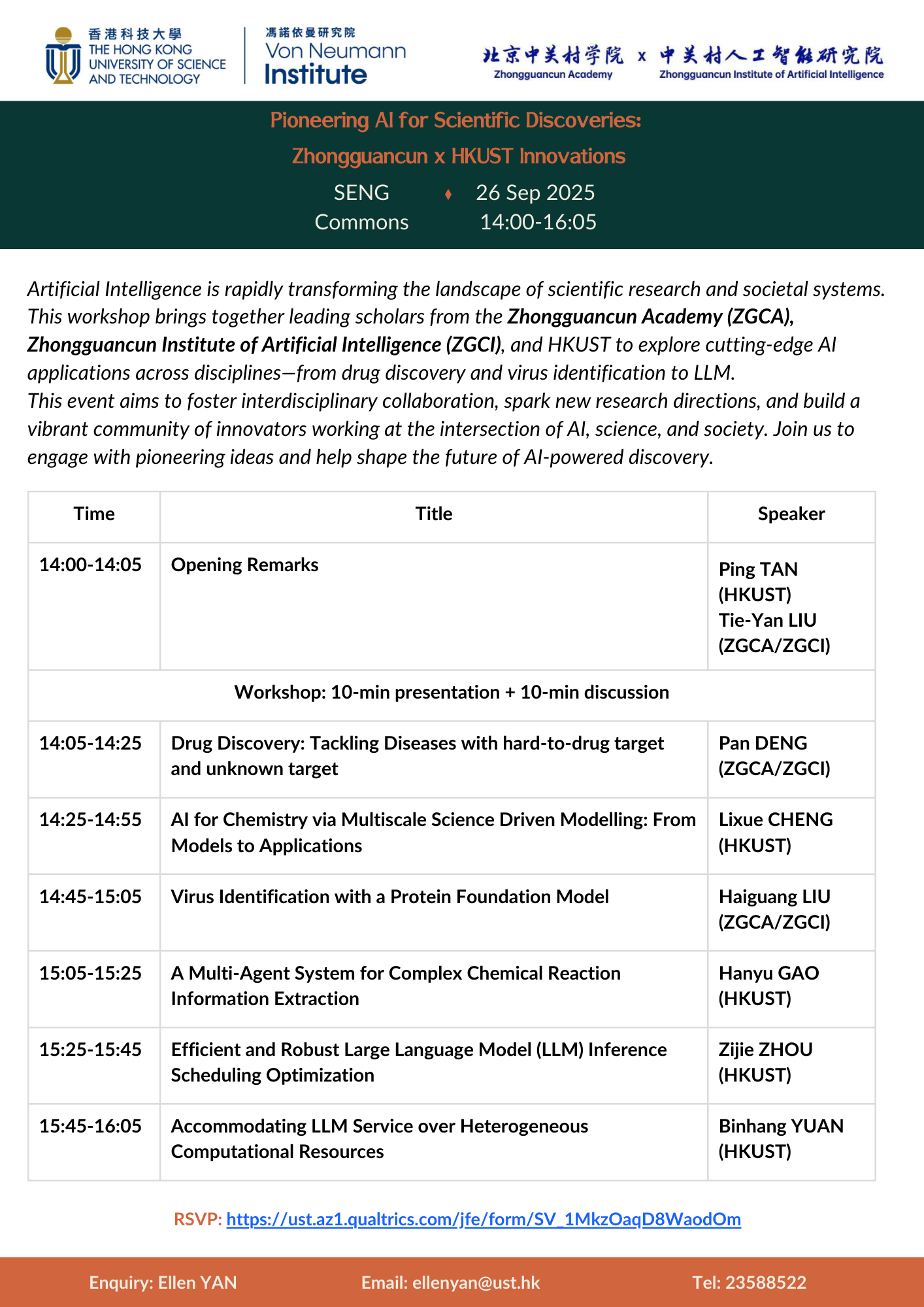
Artificial Intelligence is rapidly transforming the landscape of scientific research and societal systems. This workshop brings together leading scholars from the Zhongguancun Academy (ZGCA), Zhongguancun Institute of Artificial Intelligence (ZGCI), and HKUST to explore cutting-edge AI applications across disciplines—from drug discovery and virus identification to LLM.
This event aims to foster interdisciplinary collaboration, spark new research directions, and build a vibrant community of innovators working at the intersection of AI, science, and society. Join us to engage with pioneering ideas and help shape the future of AI-powered discovery.
Workshop: 10 min presentation + 10 mins discussion
1) Drug Discovery: Tackling Diseases with Hard-to-drug Target and Unknown Target by Pan DENG (ZGCA/ZGCI)
2) AI for Chemistry via Multiscale Science Driven Modelling: From Models to Applications by Lixue CHENG (HKUST)
3) Virus Identification with a Protein Foundation Model by Haiguang LIU (ZGCA/ZGCI)
4) A Multi-Agent System for Complex Chemical Reaction Information Extraction by Hanyu GAO (HKUST)
5) Efficient and Robust Large Language Model (LLM) Inference Scheduling Optimization by Zijie ZHOU (HKUST)
6) Accommodating LLM Service over Heterogeneous Computational Resources by Binhang YUAN (HKUST)
-
Sept 26 2025
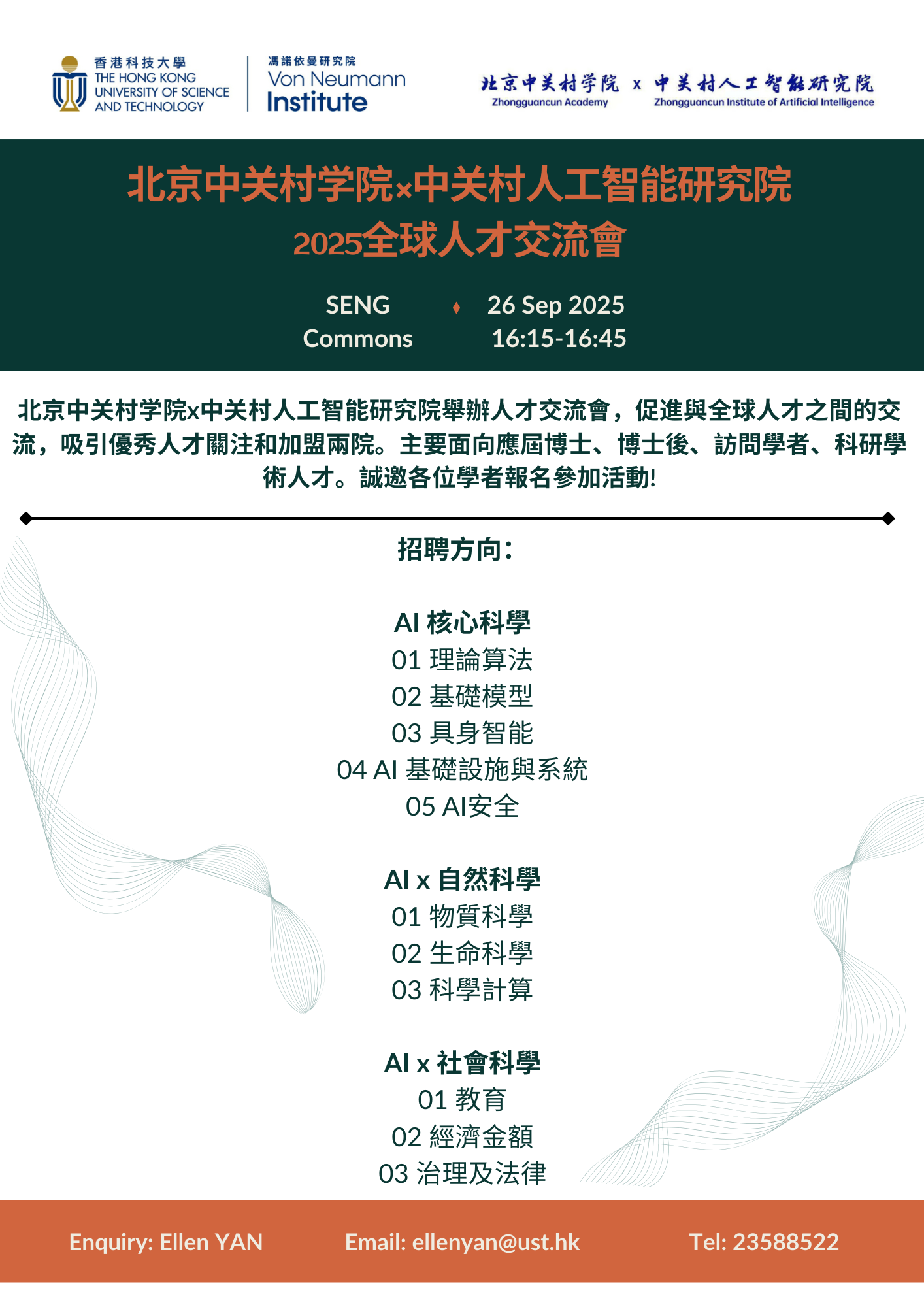
北京中关村学院×中关村人工智能研究院
2025全球人才交流會
日期:2025年9月26日 (五)
時間:16:15-16:45
地點:SENG Commons
-
Sept 26 2025
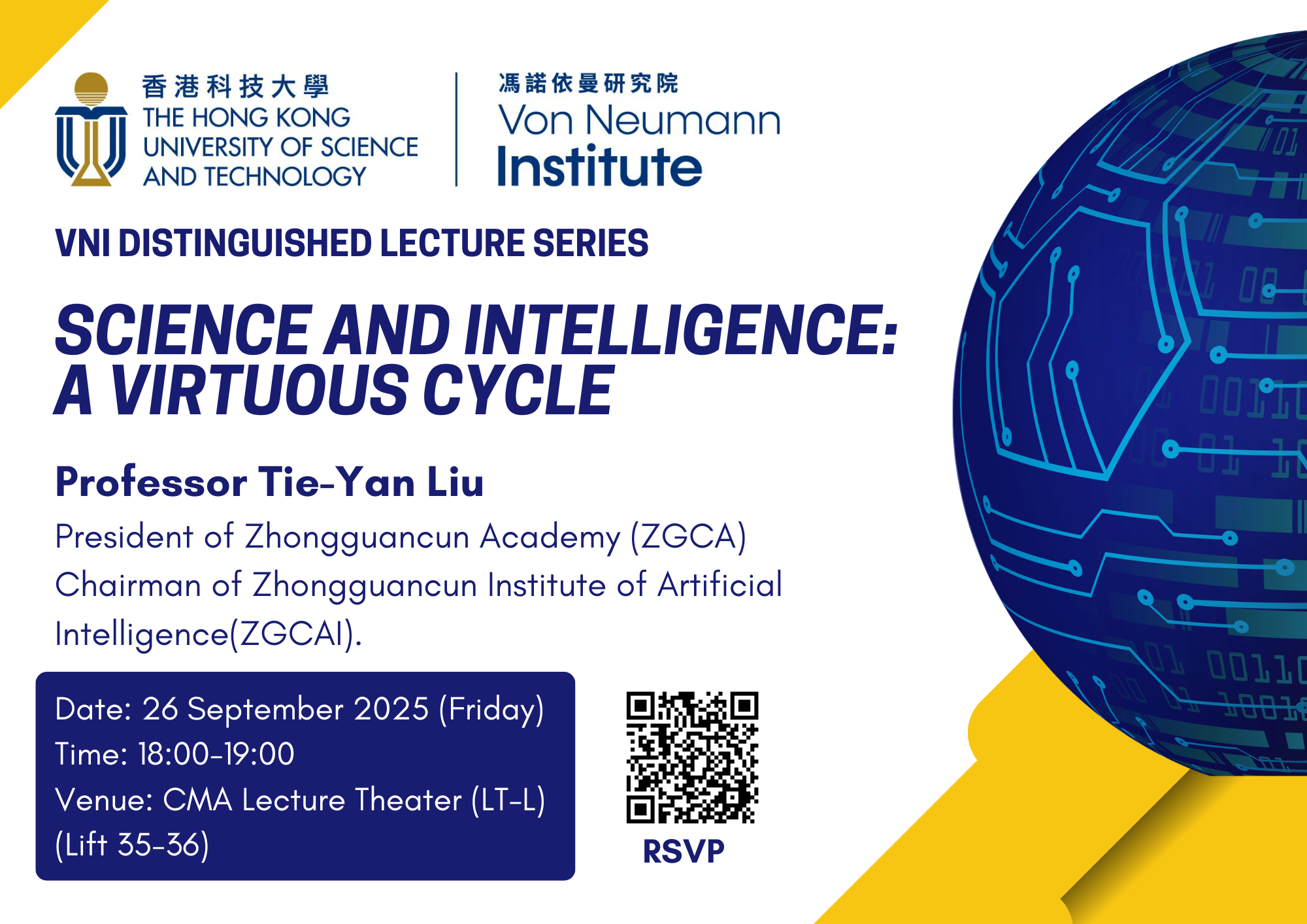
VNI Distinguished Lecture Series
Science and Intelligence: A Virtuous Cycle
Speaker: Professor Tie-Yan Liu, President of Zhongguancun Academy (ZGCA), Chairman of Zhongguancun Institute of Artificial Intelligence(ZGCAI)
Date: 26 September 2025
Time: 18:00-19:00
Venue: CMA Lecture Theater (LT-L) (Lift 35-36)
Abstract
Artificial Intelligence (AI) is revolutionizing our world, transforming everything from daily life to the fundamental pursuit of scientific discovery. As AI evolves into a new paradigm for scientific research, a critical question emerges: what is the deeper relationship between intelligence and science itself?
This lecture will explore this fascinating synergy. I will begin by re-examining the core concepts of "intelligence" — as the fundamental capacity for problem-solving that this process requires, and "science" — not just as a body of knowledge, but as a process for uncovering the laws of the universe.
I will argue that this relationship is a virtuous cycle: science is the engine that creates intelligence (both human and artificial), and this enhanced intelligence, in turn, accelerates the process of science. This will be illustrated by examples, including some of our recent progress, in scientific discovery enabled by AI and how we design better AI under the guidance of scientific principles. Today, we stand at a pivotal moment, pushing against the limits of carbon-based human intelligence (HI) by creating silicon-based intelligence (AI).
The lecture will conclude by envisioning a future of collaborative discovery, where the combined power of HI and AI continues to propel this virtuous cycle forward, leading us to a deeper understanding of the universe than ever.
About the Speaker
Tie-Yan Liu, President of Zhongguancun Academy (ZGCA), Chairman of Zhongguancun Institute of Artificial Intelligence(ZGCAI).
An internationally renowned AI expert, Strategic Scientist of the "Hai Ju Project," Council Member of the Chinese Information Processing Society, and Academic Committee Member of Changping Laboratory. He previously served as Assistant Managing Director of Microsoft Research Asia and Distinguished Scientist of Microsoft Research AI for Science. He is a Fellow of the IEEE, ACM, and AAIA.
With a long-standing focus on information retrieval and AI, he has achieved remarkable accomplishments in both academia and industry. His work has significantly contributed to bridging the gap between machine learning and information retrieval, as well as advancing scientific discovery and industrial development through artificial intelligence. Recognized for his groundbreaking contributions, he was named one of the "100 Most Influential AI Scholars Globally Since 1943" by the International Open Benchmarking Council.
-
May 21 2025
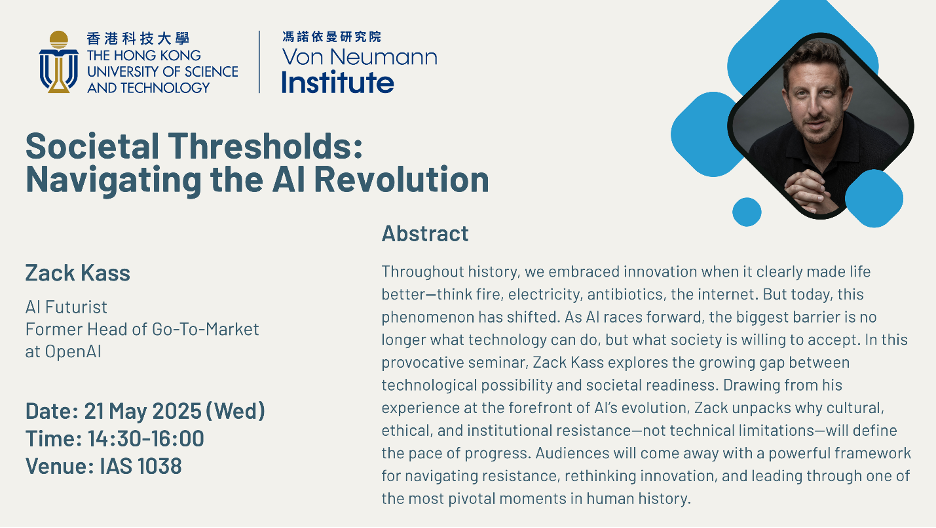
Societal Thresholds: Navigating the AI Revolution
Speaker: Zack Kass (Former Head of Go-To-Market at OpenAI)
21 May 2025
Time: 14:30-16:00
Venue: IAS 1038
Abstract
Throughout history, we embraced innovation when it clearly made life better—think fire, electricity, antibiotics, the internet. But today, this phenomenon has shifted. As AI races forward, the biggest barrier is no longer what technology can do, but what society is willing to accept. In this provocative seminar, Zack Kass explores the growing gap between technological possibility and societal readiness. Drawing from his experience at the forefront of AI’s evolution, Zack unpacks why cultural, ethical, and institutional resistance—not technical limitations—will define the pace of progress. Audiences will come away with a powerful framework for navigating resistance, rethinking innovation, and leading through one of the most pivotal moments in human history.
About the Speaker
Zack Kass is a globally recognized AI advisor and thought leader. With over 16 years of industry experience, he most recently served as Head of Go-To-Market at OpenAI, where he built the company's sales, solutions, and partnerships teams. Zack now advises Fortune 1000 companies and global institutions on long-term AI strategy and transformation. He also serves as Executive-in-Residence at the University of Virginia’s McIntire School of Commerce, where he contributes to curriculum development and discourse on the socioeconomic impact of AI.